
Bowling rules on this site cover scoring: 10 frames, strikes and spares, the pocket and splits, and how oil changes the hook. It is not a full rulebook. Fouls, slow play, and equipment checks belong in a real house; this site does not call them. The lane follows common ten-pin sizes: 60 feet (18.29 m) long, 41.5 inches wide, 39 boards. Pins are 15 inches tall and about 3 lb 6 oz (1.53 kg). Pinfall is rigid-body collision, not a canned animation.
Ten frames, scored by pins knocked down
Frames 1 through 9 give you up to two shots. If the first ball is not a strike, the second ball tries the pins that remain. If both shots leave pins, you score what fell: an open frame. The scoresheet marks strikes, spares, and splits.
Twelve strikes in a row is a perfect game: 300. Career targets and stars follow that level's brief; you may not play a full 10 frames. Daily Challenge is 6 frames. Party play can be 3, 5, or a full 10-frame game.
A strike adds the next two shots; a spare adds the next one
Knock all 10 down on the first ball and it is a strike (X): 10 plus the next two shots. Clear the rack in two and it is a spare (/): 10 plus the next shot.
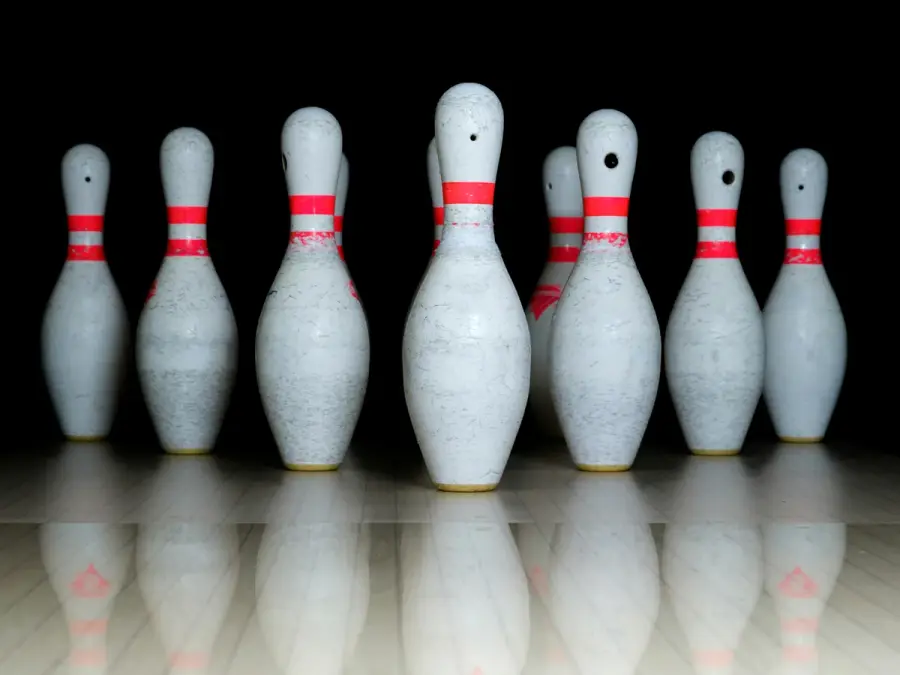
- Strike 10, plus the next two shots. A strike followed by 7 and 2 in the next frame is 19 in that frame.
- Spare 10, plus the next shot. A spare followed by an 8 is 18 in that frame.
- Frame 10 A strike or spare adds bonus balls, so this frame can have three shots. Those balls only finish the strike or spare. There is no 11th frame.
A strike in frame 10 gives you two more shots. A spare on the second ball gives you one more. If both shots leave pins, the frame ends and you do not get a bonus ball.
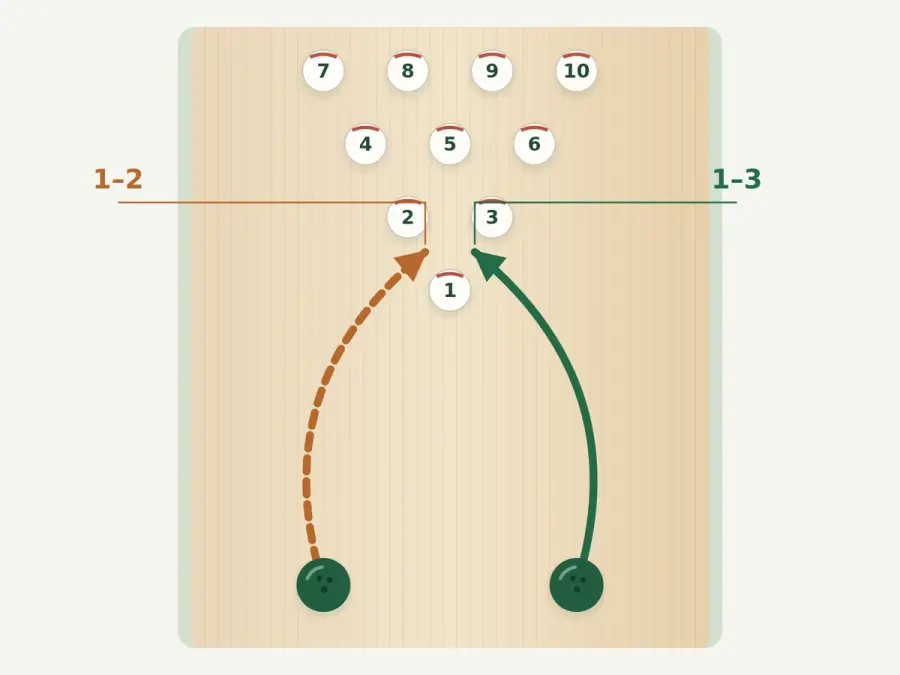
For a right-handed player the pocket is between the 1-pin and the 3-pin
The 1-pin is the head pin. A strike for a right-handed player aims the 1-3 pocket; for a left-handed player, the 1-2. A straight hit enters at about 1 degree and often leaves the 5-pin or 10-pin. A hooking ball cuts in at about 4 to 6 degrees and carries the rack.
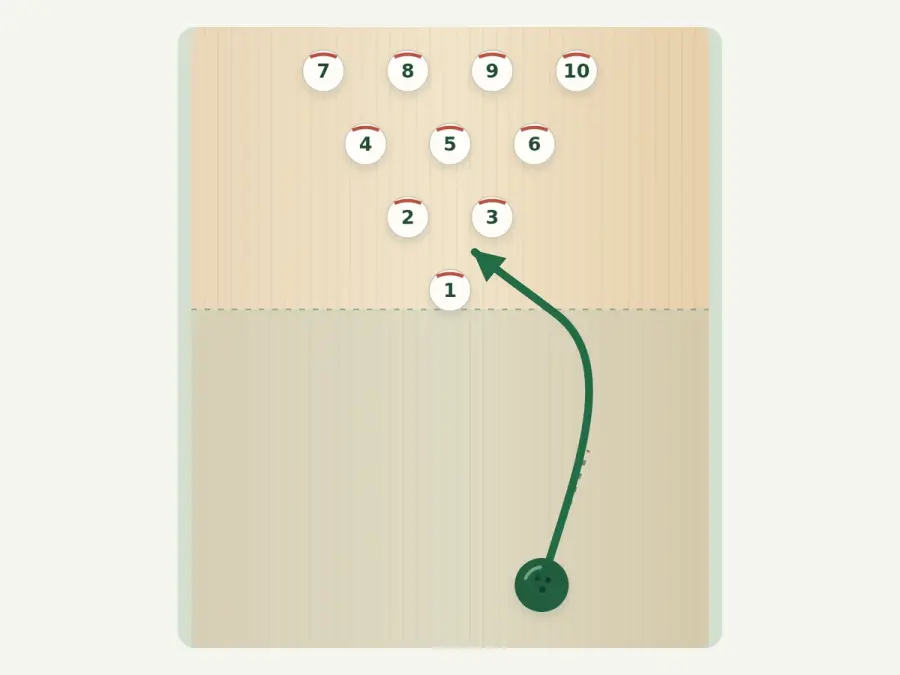
The ball skids on oil, then hooks on the dry
The fronts of a real lane are oiled. The ball spins on oil but barely turns. Friction rises off the oil, the side rotation hooks toward the pocket, then the ball true-rolls. Short oil hooks early; long oil waits. A house shot is heavier in the middle and drier outside, so it pulls a missed ball back. A sport pattern is flatter and will not save a miss.
Coverstock, radius of gyration (RG), rev rate, and axis rotation all change that arc. The path before release is a prediction from the same physics. Practice can switch among five oil patterns; Career Mode sets oil per level. The oil model is not calibrated against real-world data, and it is not a professional training simulator.
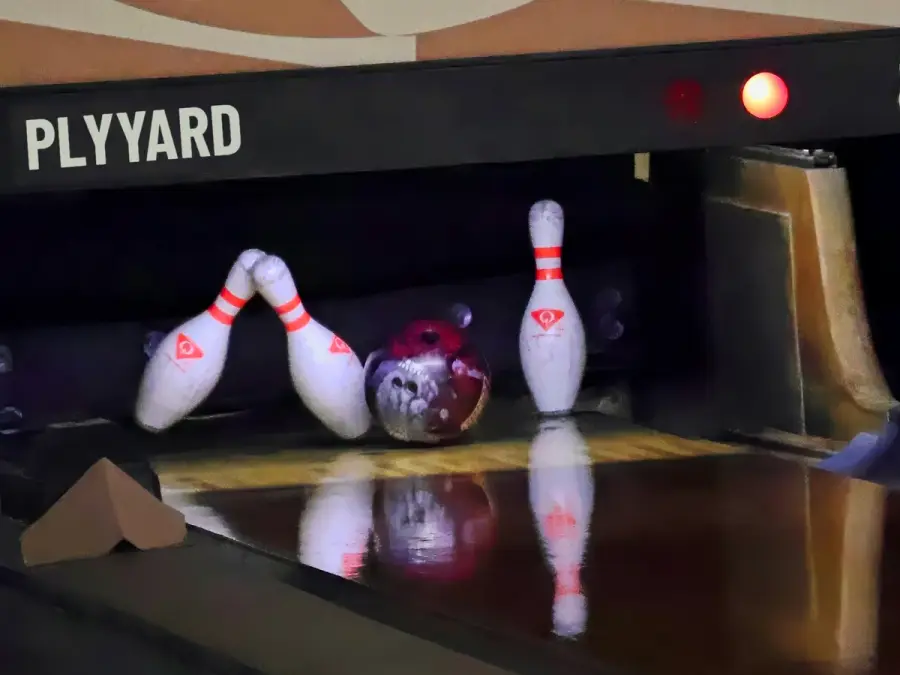
Head pin down with a gap in the pins that remain is a split
Splits are marked in red. Baby splits such as 2-7 and 3-10: clip the pin closer to you so the ball or that pin carries into the other. 4-5 and 5-6: hit the front pin thin so it slides. The 7-10 is one of the hardest leaves; you usually need a pin to fly sideways or bounce back.
Chapter 4, Split Master, is built around these leaves. Straight spares and a crossed stance are on the playing tips page.
Drag sideways for stance, swipe up to throw
The white ring is the board you stand on. Hold and swipe up; a faster swipe is a faster ball, and the swipe direction is the launch angle. Curve left at the end for a left-hand rotation, right for the other way. A bigger bend means more revs. Start with a small hook into the pocket, then add rotation.
On a keyboard, arrows set stance, A / D set angle, Q / E set rotation. Hold space to charge, release to throw. Tap while the ball is rolling to speed it up. Tap during the pinsetter cycle to skip it.
This site scores collisions. Progress stays in this browser
Scoring follows the 10 frames, strikes, and spares above. The difference is what we check, and how you throw.
- Pinfall: Ball-to-pin and pin-to-pin run at 120 steps a second, not a canned clip.
- Not called: Foul line, slow play, and equipment. A real match still checks those.
- Hint and replay: Against the computer, hint draws a pocket line from your stance. Replay shows the last shot at 0.4×. Hint does not throw for you.
- Progress: Stars, unlocked balls, and career records stay in local storage. They are not uploaded and do not sync to other devices.
Rules questions
How do you score bowling? How many points is a strike or a spare?
A game has 10 frames, and in frames 1 through 9 you get up to two rolls. Knock down all 10 pins on your first roll and it is a strike (X): you score 10 plus the pins from your next two rolls. Knock them all down in two rolls and it is a spare (/): you score 10 plus the pins from your next roll. Otherwise you score the pins you knocked down. A strike or spare in the 10th frame earns bonus rolls. Twelve strikes in a row is a perfect game: 300.
Why can frame 10 have three shots?
Bonus balls only finish a strike or a spare. A strike in frame 10 gives you two more shots; a spare on the second ball gives you one more. If both shots leave pins, the frame ends. There is no 11th frame.
Why does a straight shot into the pocket still leave pins?
The entry angle is too small, so the ball kicks off the head pin and the energy never reaches the back row. Side rotation raises the entry to about 4 to 6 degrees, and the rack carries.
Where is the pocket for a left-handed player?
Between the 1-pin and the 2-pin. Right-handed players throw the 1-3. Turn on Hint and a gold line shows a pocket path from where you stand.
Why did the same throw hook earlier this time?
Shorter oil, or a coverstock that reads sooner, means the ball leaves the oil earlier. Changing the ball or the oil changes the result.
Does this site call fouls or slow play?
No. A real match still checks those. This site scores pinfall from collisions, using the 10 frames, strikes, and spares above.
Does Career Mode always play 10 frames?
Not always. Each level follows its own brief. Daily Challenge is 6 frames. Party play can be 3, 5, or 10 frames.
Do I need an account? Where is progress saved?
No. The game runs in the browser with WebGL. Stars and unlocked balls stay in this browser. Clearing site data or using a private window can erase them.
